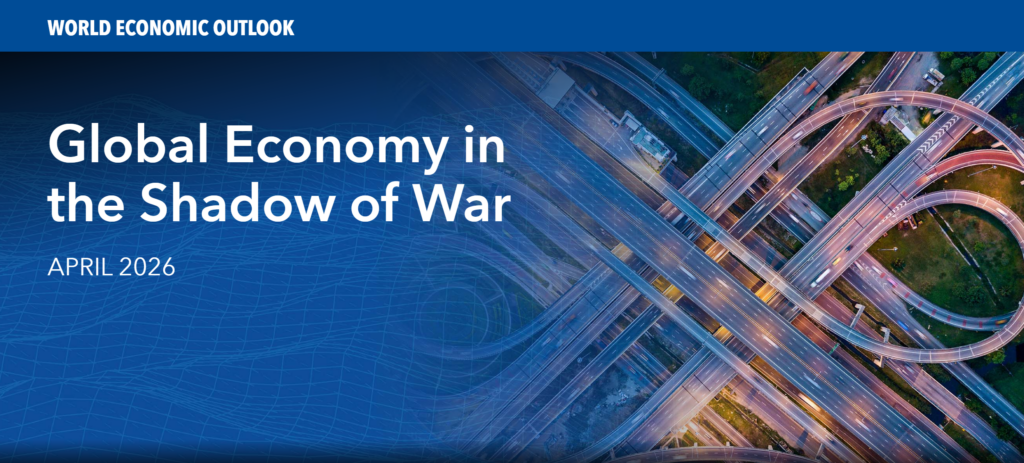
According to the International Monetary Fund, the global economy faces renewed tests as the war in the Middle East threatens to disrupt growth and disinflation.
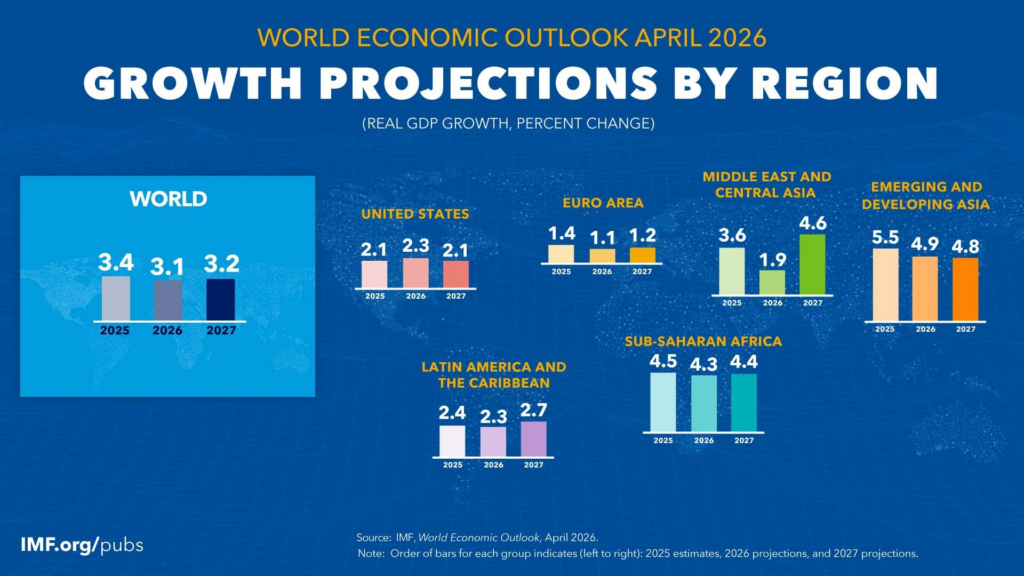
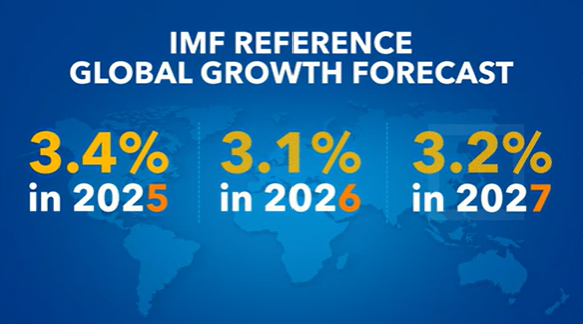
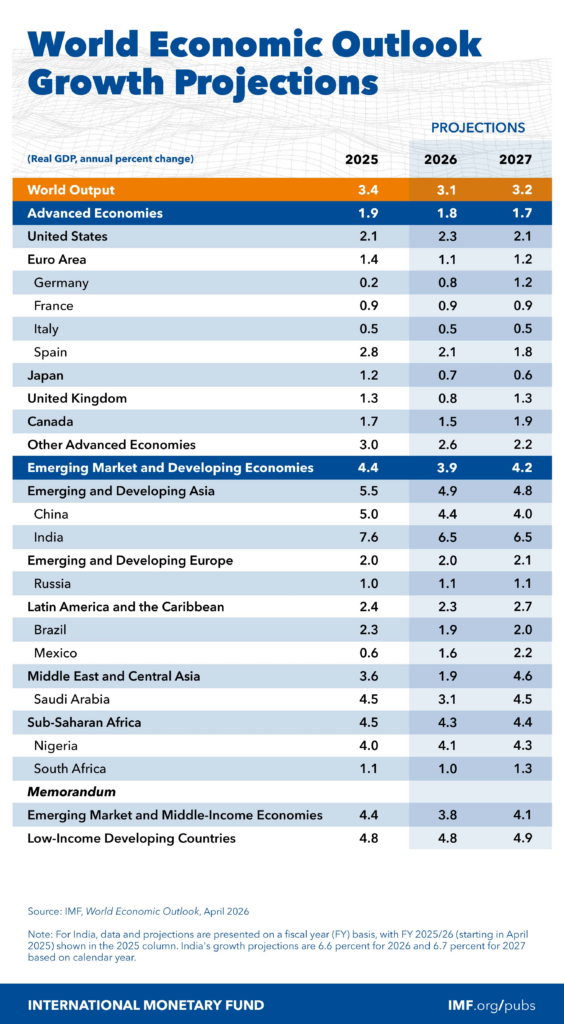
After withstanding higher trade barriers and elevated uncertainty last year, global activity now faces a major test from the outbreak of war in the Middle East. Assuming that the conflict remains limited in duration and scope, global growth is projected to slow to 3.1 percent in 2026 and 3.2 percent in 2027. Global headline inflation is projected to rise modestly in 2026 before resuming its decline in 2027. Slowdown in growth and increase in inflation are expected to be particularly pronounced in emerging market and developing economies.
Downside risks dominate the outlook. A longer or broader conflict, worsening geopolitical fragmentation, a reassessment of expectations surrounding artificial‑intelligence‑driven productivity, or renewed trade tensions could significantly weaken growth and destabilize financial markets. Elevated public debt and eroding institutional credibility further heighten vulnerabilities. At the same time, activity could be lifted if productivity gains from AI materialize more rapidly or trade tensions ease on a sustained basis.
Fostering adaptability, maintaining credible policy frameworks, and reinforcing international cooperation are essential to navigating the current shock while preparing for future disruptions in an increasingly uncertain global environment. As Chapter 2 shows, scaling up of defense spending prompted by a rise in geopolitical tensions could boost economic activity in the short term but also bring about inflationary pressures, weaken fiscal and external sustainability, and risk crowding out social spending, which could in turn ignite discontent and social unrest. As Chapter 3 demonstrates, where conflict erupts, acute macroeconomic trade-offs and scarring follow and last well beyond the immediate wartime shock.
Chapter 2: Defense Spending: Macroeconomic Consequences and Trade-Offs
Defense spending is rising amid intensifying geopolitical tensions. This chapter finds that large defense spending booms have become more frequent, especially in emerging market and developing economies. In a typical boom, defense outlays increase by about 2.7 percentage points of GDP over two-and-a-half years, with roughly two-thirds financed through deficit. While defense buildups can boost economic activity in the short term, they also temporarily increase inflation and create significant medium-term challenges. Fiscal deficits worsen by about 2.6 percentage points of GDP, public debt increases by about 7 percentage points within three years, and external balances deteriorate. Wartime booms are especially costly, with public debt jumping by about 14 percentage points and social spending falling. Defense spending multipliers are close to 1, on average, but vary widely depending on how spending is sustained, financed, and allocated and how much equipment is imported.
The Full report of the IMF on the World Economic Outlook will be published on April 30, 2026.
Further Reading: