
Otto Granados
A few weeks before the operation that led to the capture and death of Nemesio Oseguera (a.k.a. El Mencho), Mexico’s most notorious drug lord, Eduardo Guerrero, an expert on security and organized crime in Mexico, was asked why the Jalisco New Generation Cartel (CJNG) had not been targeted. Guerrero replied: “There is a tremendous fear that if they attack it, it will generate great internal instability or lead to rifts at the top that will end up fragmenting the organization and, with that, lethal violence will grow exponentially.”

As of now, it is too early to know whether this hypothesis will materialize or not, so it is advisable to proceed by approximation to try to clear up some valid doubts. The first is to find out in a reasonable way how the February 22 operation (22-F) unfolded; the second is to determine the risks of the hydra effectively reemerging with multiple heads; the third is whether the action will mitigate organized crime or, like energy, simply transform it; and the fourth is to understand what happens to other aspects of the business model, such as money laundering, for example.
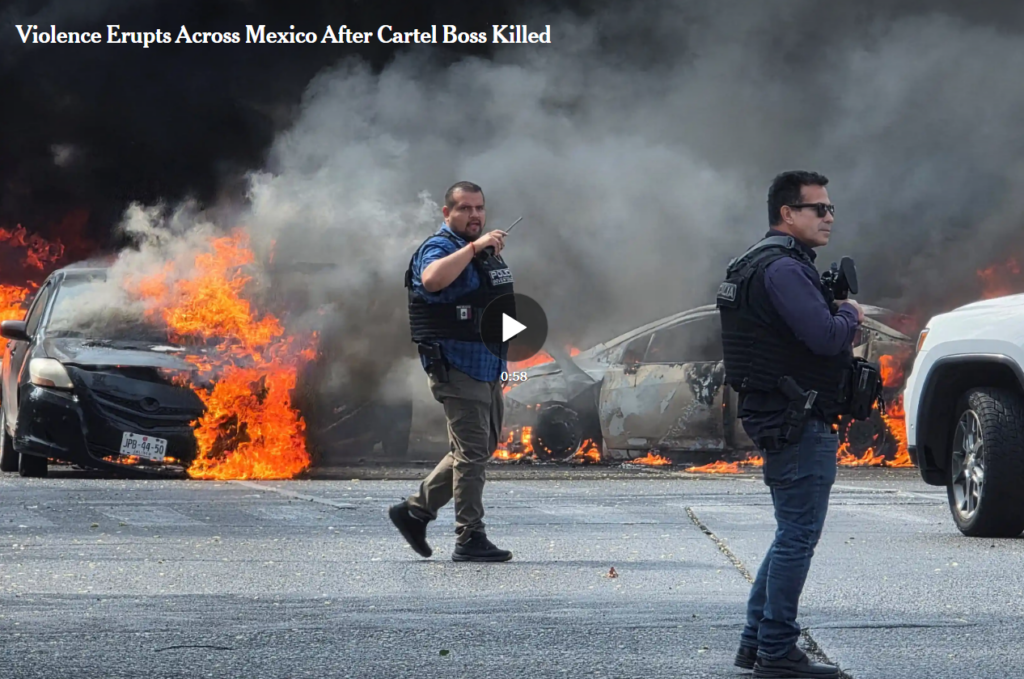
First, given the poor ex post communication strategy followed by the Mexican government and the confidential aspects that are naturally unknown, the way in which the operation was carried out is rife with speculation, some of which makes sense. For example, the total number of casualties on both sides—the Mexican army and criminals—about 60 people, seems relatively low given the level of lethality, firepower, and sophistication of the equipment—helicopters, anti-aircraft weapons, rocket launchers, radar jammers, and so on—plus the drug lord’s security and protection rings—there is talk of 400 bodyguards—which, in theory, could have unleashed an indescribable bloodbath.
Now, if, as has been said, the tactical and strategic intelligence design behind the operation was carried out by the United States, which also provided joint training by special forces, surveillance drones, and data from the FBI and CIA, why had this design not been previously developed by the Mexican authorities, given that this was a cartel that had been operating for at least a decade? Was there negligence, complicity, inefficiency, low or no intelligence capacity, or a little of everything?
Last January, the US Department of War clearly stated in its National Defense Strategy that it would take direct action against specific targets such as cartels now labeled as Foreign Terrorist Organizations (FTOs). Given the high level of mistrust between US agencies and their Mexican counterparts, was it enough to put the plan in black and white, provide assistance, leave the operation entirely in Mexican hands, and settle for monitoring it from a situation room in Washington with a cup of coffee in hand? Obviously not.

What’s more, there are relatively well-founded doubts about the circumstances surrounding the drug lord’s death—during his air transfer to Mexico City—because if he had remained alive, he would have been extradited the next day and taken to a court in New York. In other words, he would have been a source of privileged information about the structure of the business and the complicity of very high-level government, political, military, and police figures with organized crime.

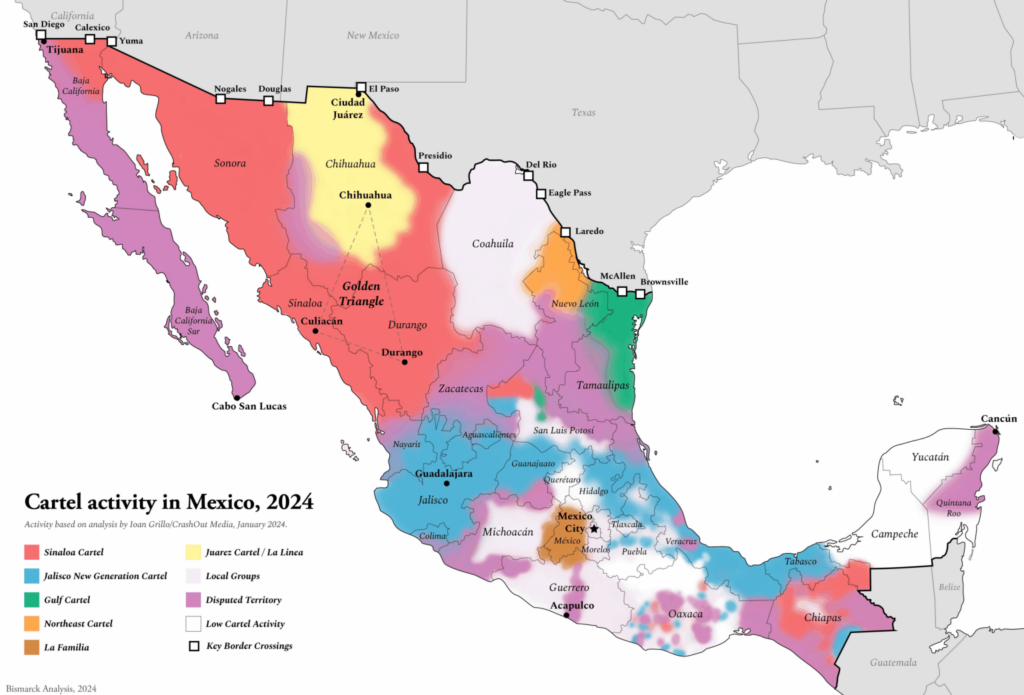
Once the dog is dead, is the rabies over? That is the second question. Clearly not. Organized crime was and is a very important power center in Mexico, which was already conveniently fragmented, as reported by various sources. One (https://shorturl.at/sY6KD) reviewed more than 50 government intelligence reports in 2022 and estimated that there are more than 80 organized crime groups and around 16 criminal gangs in Mexico. Another, from the US Congressional Research Service, estimates that crime controls one-third of the national territory. And yet another, the day after the episode, from The Wall Street Journal, citing the DEA, noted that, to a greater or lesser extent, between three and five major cartels have a presence in all 32 Mexican states.
Within this criminal framework, which is not monolithic, there is a constellation of organizations that compete with each other, fighting ruthlessly for business, where the only law is the one each imposes in its own realm, because that is the only way to survive.
Although the operational model of organized crime, as we will see later, is very efficient, the disappearance of a major drug lord creates a powerful incentive for new leaders in more limited territories and in varied business portfolios. Why would the second or third in command of the kingpin in Jalisco or other states, who already have significant experience and a very broad and varied network of allies, leave such a profitable and attractive business simply because the boss is dead? Let us remember that Pablo Escobar was killed in 1998, but Colombia, according to the UN Office on Drugs and Crime, remains the leading producer of cocaine 28 years later.

A central question is what role the Mexican army will play in the immediate future. For now, the Navy, which in Mexico operates separately from the land and air forces and was once more or less reliable in the eyes of the US, has been excluded from the operation due to abundant evidence that its senior officers have been involved in fuel smuggling, among other things, so the army is buying time around two possibilities.
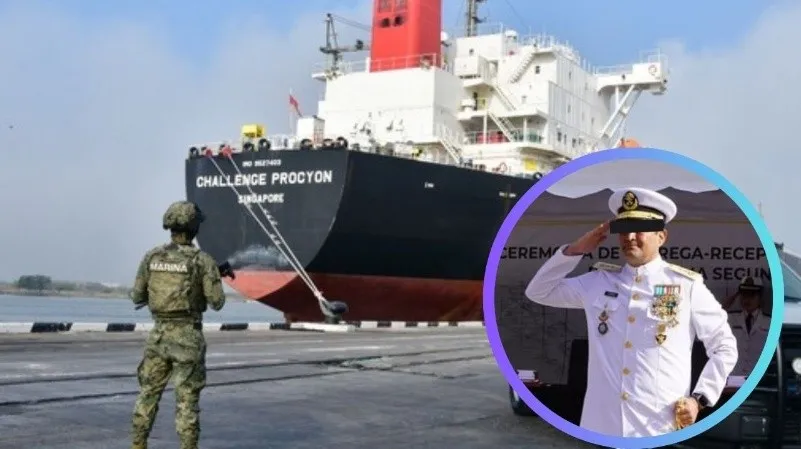
One is that, as some parts of the army have been colluding with criminals and/or illicit businesses in the public entities they administer (customs, airports, ports) and depend on the military chain of command, it is normal for them to maintain a tactical retreat until the waters calm down, for the sake of mere survival and protection—the “balance of fear” as it is called in the investigation. The other option is that, at the most primitive levels of the army and police, which act directly on the ground as a “protective cordon,” they quickly regroup under the new crime bosses so as not to slow down a monetary drain to which they have already become addicted.
This is the next key issue, perhaps the most powerful: “follow the money,” Deep Throat advised the Watergate investigators. In other words, it is one thing to eliminate the leader and perhaps dismantle the hierarchy, but quite another to put an end to the business. “Get money first; virtue will follow,” advised Horace, the Roman poet, more than twenty centuries ago.

Let’s put it this way: criminal organizations have an increasingly diversified and complex business portfolio. From their traditional activities—production, trafficking, and marketing of narcotics—they have expanded into fuel smuggling, transportation, extortion, kidnapping, private security, the construction industry, and a long and imaginative list of other activities. In Moisés Naím’s equation, the success of organized crime does not lie in the type of goods it provides, but in the business model it operates under, as can be seen in the detailed accounts kept by Oseguera, leaked by the Mexican government to the media (https://shorturl.at/KYgx9).

The illicit business operates based on impeccable market logic: it identifies a need, designs a good plan, produces a sought-after good, builds sophisticated logistics, and satisfies consumers. This is how any efficient company operates, whether it is producing and distributing bread, soft drinks, or designer clothing, or trading in drugs, counterfeit medicines, prohibited weapons, works of art, or people, as is the case with the trafficking of Chinese nationals in New York.

Is there anything extravagant about this process? No, and even less so if the various Mexican government agencies do not understand it or, worse still, if they do not want to understand it because they are part of the supply chain.

Never before has crime managed to set up a structure in which, to begin with, they are situated in the midst of corporate modernity because they no longer work from pyramidal forms of control and coordination but through horizontal networks in which a large number of public and private actors participate who are highly flexible in responding to market and customer requirements and who are skilled enough to move quickly from one sector of goods—say, traditional drugs—to others that are equally attractive and profitable.

But, in addition, part of the failure of many governments’ strategies to combat organized crime can be explained by their focus on security rather than on developing an economic strategy—based on insight, skill, and data—to contain a business that operates according to market logic.

Herein lies the heart of the model: it is a nervous system lubricated with money, or rather, condensed into the need to manage, invest, launder, or transfer large sums of money. For example, in 2025 (https://lapera.mx/mas-billetes-mas-sospechas/), Alejandro Werner, a former senior IMF official, reported that in the midst of the digital age, the use of cash in the Mexican economy has increased in a highly worrying manner: “Cash in circulation as a proportion of GDP is around 10%. In 2014, it was less than half that. Furthermore, it is the highest among Latin American economies of comparable size and development.”

Of course, not all of this process can be attributed to drug trafficking, extortion, or gasoline smuggling; it can also be explained by the informality of the Mexican economy (55%), tax evasion, public and private corruption, and, of course, money laundering. It is very difficult at this point to reach definitive conclusions about the 22-F operation, but it is critical to understand the business model of organized crime better.

Finally, there is the relationship with the United States. Historically, the binational agenda has been, is, and will continue to be the most important for Mexico, and, not insignificantly, in July 2026, the “review” of the Free Trade Agreement, on which more than 80% of the Mexican economy depends, will begin. Therefore, in the strategy against FTOs, the White House has and will continue to have the greatest weight in decision-making, no matter how much Mexican nationalism tries to sugarcoat it for the gallery with a few spoonfuls of sovereignty and patriotism.

In short, is 22-F the beginning of the end or the end of the beginning? It is too early to tell, Comrade Deng would say.
Further Reading: