

Ricardo Pascoe Pierce
The National Institute of Statistics and Informatics (INEGI) produced a flood of “good data” to cheer up the president at the end of the year: more jobs, a larger middle class, more foreign investment, higher per capita incomes, lower inflation, and better prospects for 2026. Figures were also published showing crime and violence, in all its forms, in sharp decline thanks to aggressive federal security policies. It couldn’t be better. So why doesn’t the social mood match this picture of supposed success?

The main reason is the decline in Mexicans’ real incomes. When the gross domestic product does not grow (0.3% is considered zero growth, even in a recession), while the population continues to increase and demand more jobs, food, and other necessities, per capita income decreases. Today, we Mexicans are, on the whole, poorer than we were a year ago, despite the distribution of cash through social programs.
Although “good” macroeconomic and political data are announced as a generalization for the country, at the street level, in neighborhoods and towns, that good news simply has not arrived and, more importantly, has not been felt. A simple fact: it is estimated that Christmas or New Year’s Eve dinner costs, on average, 12% more than last year. Is that 12% a lot or a little? Neither one nor the other. It is a lot because of what it represents. A 12% increase means that the production and distribution chain of products and services throughout the economy has become at least that much more expensive during the year. This calculation comes from service chambers, such as restaurants and food suppliers. They are the ones who, without theory and much less without politics, determine what their affiliates should charge to make their businesses profitable.

The government boasts that Mexico has the second-lowest unemployment rate in the world, surpassed only by Japan. But in that Asian country, the data refers to the total number of people of working age and does not include so-called “informal work,” because it practically does not exist there. In Mexico, the 2% unemployment figure is misleading, as only a minority of workers are employed in the formal sector and pay taxes. The vast majority (54%) subsist in the informal sector, without benefits or social security. By extolling the 2% unemployment rate, the government is celebrating that reality, without realizing what it says and what it means for the people. The government is deceiving itself with its statistics, to please itself, but not to solve problems.

INEGI provided data that the government does not highlight: the informal labor sector is growing, while the formal labor sector is shrinking. What is the explanation for this obvious setback? There may be many external and internal factors. Still, their combination tells a story of suffering: formal companies are closing and becoming informal (they stop paying taxes and eliminate benefits for their workers to survive) or disappearing altogether, resulting in the dismissal of their staff. The net effect of the growth of informal work is that the deficiencies we Mexicans suffer in health, education, and basic necessities of life have increased exponentially.

The inevitable conclusion is that the working class in the country is increasingly impoverished, despite social support and increases in the minimum wage. Therefore, to claim, as the government does, that there is more middle class than “poor class” in Mexico is the product of mathematical cynicism that has no justification or explanation beyond the political rhetoric of a government overwhelmed by its internal and external burdens.

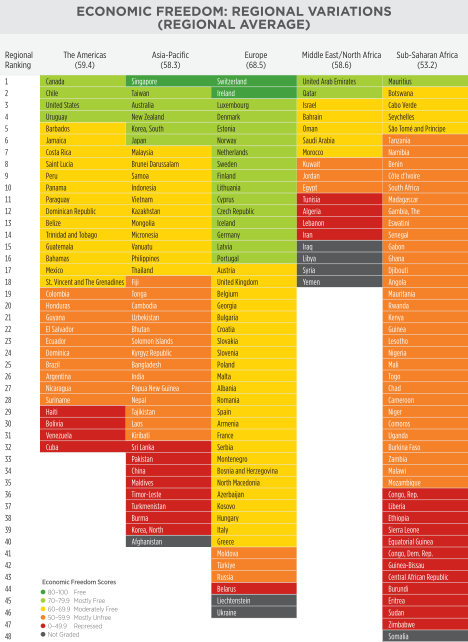
In the Economic Freedom and the Informal Economy Index, Mexico ranks 91st, below countries such as Bolivia, Ecuador, Colombia, Argentina, Honduras, Guatemala, Brazil, Peru, Panama, Uruguay, and Chile. There is nothing to boast about in terms of the exercise of freedom and the informal economy. Of course, we are above Nicaragua and Venezuela, but with them, the yardstick for comparison is practically non-existent.
In response to the official announcement claiming a significant reduction in violence, independent security experts assert that the change in methodology artificially softens the reality and allows the government to speak of a drop in intentional homicides. The authorities changed the measurement methods, creating categories such as “other crimes against life,” where they hide a large number of homicides. Additionally, during this administration, “disappearances” have increased, which has also served as a category to hide other intentional homicides. In fact, reports of disappearances have increased compared to the previous administration.

In conclusion, concerning intentional homicides, taking into account all the indicators of the actual levels of violence in the country, it can be said that there has been nowhere near the decrease that the government proudly announces. Neither poverty nor violence in Mexico has been reduced. These are unresolved issues, while the country awaits the arrival of a government capable of addressing the just demands of a dissatisfied population.

@rpascoep
Further Reading: