
New World Order: Power, Threats, and Alliances.

The article discusses the escalating geopolitical tensions driven by US interventions, particularly in Venezuela, which are reminiscent of Russia’s actions in Ukraine. It critiques Mexico’s lack of coherent foreign and national security policies under its current leadership, highlighting the risks posed by external threats and internal inconsistencies.

The Time To Decide Is Running Out.

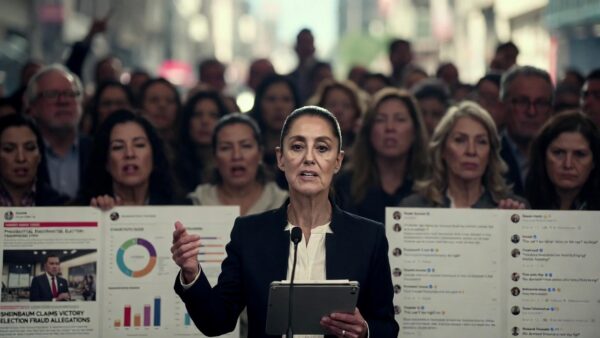
Ricardo Pascoe Pierce discusses the political challenges facing President Claudia Sheinbaum as she navigates control exerted by former President Andrés Manuel López Obrador. Drawing parallels to Lázaro Cárdenas’ actions in 1936, he highlights her struggle for autonomy in a contained crisis, culminating in an uncertain political landscape as the 2027 elections approach.

The Collapse of International Diplomacy in the Trump Era.

Since the Congress of Vienna in 1815, the need for institutional mechanisms to prevent chaos has been clear. The U.S. played a pivotal role in fostering global stability post-World War II, emphasizing peace over force. However, under Trump, this commitment has eroded, leading to a dangerous precedence of coercion over diplomacy.

Reading The Signals On Mexico And Cuba.

Mexico is in the eye of the storm. To navigate the new political conditions emerging on the national horizon, it is essential to adopt new paradigms and methods of analysis. Traditional arguments no longer work, given the new geopolitical configurations of the world. It is time to rethink ourselves. Venezuela’s abrupt transformation—from a lackey state of China, Russia, and Iran to a protectorate of the United States—is not simply an old-fashioned imperial phenomenon. It is a change that transforms all relations among the nation-states of the Caribbean Basin.

The Consequences of Power Concentration in Mexico.

The evolution of Mexican politics over the past 25 years has been marked by a shift from a centralized to a more decentralized power structure. Despite democratization efforts, governance issues persist, and the ruling party, Morena, has concentrated power under one leader, raising concerns about accountability and effective leadership in addressing ongoing challenges.

Iran’s Economic Crisis Fuels Rebellion Against Theocratic Regime.

In 2025, María Corina Machado received the Nobel Peace Prize for defending Venezuelan democracy. In 2023, Narges Mohammadi was awarded for her human rights activism in Iran, despite imprisonment. Current protests in Iran, fueled by economic crises and lost support from merchants, challenge the regime’s legitimacy, with calls for significant systemic change.

After Maduro’s Capture, the Shockwaves Reach Mexico.

U.S. pressure on Mexico may compel significant decisions regarding organized crime and Cuba following Nicolás Maduro’s capture. The evolving political landscape threatens Mexico’s stability, as internal dynamics and the potential influence of Cuban intelligence could impact regional security. Mexico’s pragmatic governance faces increased scrutiny from the U.S. amidst rising crime challenges.

The Double Standard of Moral Outrage in Mexican Politics.

The post criticizes the hypocrisy of leftist Mexican opinion on international law, highlighting their selective outrage against the US while defending authoritarian regimes. It argues that invoking sovereignty to protect dictators is opportunistic, noting historical examples where moral responsibility superseded legal constraints. Ultimately, it warns that ideological consistency jeopardizes Mexico’s national interest in trade and diplomacy.

Governments vs. People: Navigating Sovereignty in Latin America.

The text discusses the evolving relationship between state sovereignty and individual rights, highlighting the inadequacies of the UN in addressing modern issues. It critiques the actions of authoritarian regimes and the failure to uphold human rights, particularly in Latin America. The dilemma of defending people versus governments is central to the discussion.

Unmasking the Dual Standards in Latin American Diplomacy.

Brazil, Chile, Colombia, Uruguay, Mexico, and Spain issued a joint statement condemning unilateral military actions in Venezuela, emphasizing adherence to international law and advocating for dialogue led by Venezuelans. However, the critique highlights the hypocrisy of these nations, which previously failed to challenge Nicolás Maduro’s human rights violations and electoral fraud.

Shares