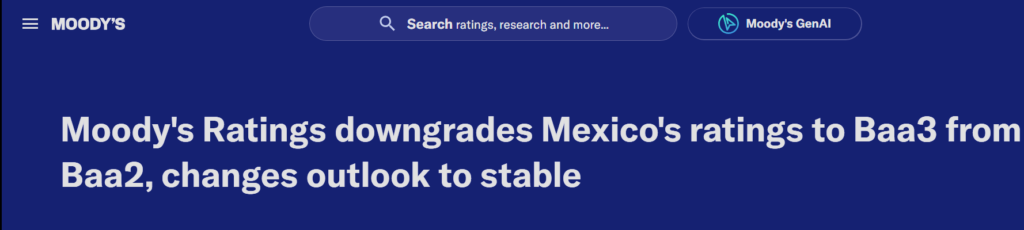
New York, May 20, 2026 — Moody’s Ratings (Moody’s) has today downgraded the Government of Mexico’s long-term local and foreign-currency issuer and senior unsecured ratings to Baa3 from Baa2, and the senior unsecured shelf and MTN programs ratings to (P)Baa3 from (P)Baa2. The outlook was changed to stable from negative.
The downgrade of the ratings to Baa3 reflects a sustained weakening in fiscal strength that accelerated in 2024 and that we expect to persist, as rigid spending, a narrow revenue base, and continued support to Petroleos Mexicanos (PEMEX) limit the government’s ability to stabilize debt in a low-growth environment. Despite efforts to reduce the fiscal deficit, other policy priorities, including energy sovereignty and a redistributive spending model, have weakened fiscal policy anchors and policy effectiveness, and contributed to wider deficits and faster deterioration in debt metrics than previously expected. Mexico’s fiscal position has weakened relative to Baa-rated peers and its vulnerability to fiscal shocks has increased, particularly as we expect economic growth to remain subdued in the near term and to return to trend growth around 2% only gradually.
The Baa3 rating takes into account a balance of factors. In particular, Mexico’s economic strength remains supported by a large and diversified economy and preferential access to the US market, which provides a durable anchor for trade and investment opportunities. The authorities’ investment-related initiatives could support a gradual improvement in economic performance over the medium term. At the same time, economic growth is constrained by structural weaknesses, including high informality, insecurity and infrastructure bottlenecks related to energy and water availability.
The stable outlook reflects our expectation that further weakening in fiscal strength will be gradual and partly offset by Mexico’s macroeconomic stability, policy responsiveness, and underlying economic strength. While ongoing support to PEMEX will continue to constrain fiscal consolidation, Mexico does not face macroeconomic imbalances that would amplify fiscal risks. Moreover, the authorities retain a demonstrated capacity to adjust monetary and macroeconomic policies in response to shocks.
Rating Action
|
11 min read
|
20 May 2026
Moody’s Ratings
New York, May 20, 2026 — Moody’s Ratings (Moody’s) has today downgraded the Government of Mexico’s long-term local and foreign-currency issuer and senior unsecured ratings to Baa3 from Baa2, and the senior unsecured shelf and MTN programs ratings to (P)Baa3 from (P)Baa2. The outlook was changed to stable from negative.
The downgrade of the ratings to Baa3 reflects a sustained weakening in fiscal strength that accelerated in 2024 and that we expect to persist, as rigid spending, a narrow revenue base, and continued support to Petroleos Mexicanos (PEMEX) limit the government’s ability to stabilize debt in a low-growth environment. Despite efforts to reduce the fiscal deficit, other policy priorities, including energy sovereignty and a redistributive spending model, have weakened fiscal policy anchors and policy effectiveness, and contributed to wider deficits and faster deterioration in debt metrics than previously expected. Mexico’s fiscal position has weakened relative to Baa-rated peers and its vulnerability to fiscal shocks has increased, particularly as we expect economic growth to remain subdued in the near term and to return to trend growth around 2% only gradually.
The Baa3 rating takes into account a balance of factors. In particular, Mexico’s economic strength remains supported by a large and diversified economy and preferential access to the US market, which provides a durable anchor for trade and investment opportunities. The authorities’ investment-related initiatives could support a gradual improvement in economic performance over the medium term. At the same time, economic growth is constrained by structural weaknesses, including high informality, insecurity and infrastructure bottlenecks related to energy and water availability.
The stable outlook reflects our expectation that further weakening in fiscal strength will be gradual and partly offset by Mexico’s macroeconomic stability, policy responsiveness, and underlying economic strength. While ongoing support to PEMEX will continue to constrain fiscal consolidation, Mexico does not face macroeconomic imbalances that would amplify fiscal risks. Moreover, the authorities retain a demonstrated capacity to adjust monetary and macroeconomic policies in response to shocks.
Mexico’s local-currency (LC) and foreign-currency (FC) ceilings were lowered to A2 from A1. The four-notch gap between the LC ceiling and the new proposed issuer rating reflects the government’s moderate role in the economy, a track record of predictable and reliable macroeconomic policymaking, moderate political and low external vulnerability risks. The alignment between LC and FC ceilings reflects the absence of transfer and convertibility risks, itself anchored in a history of strong economic institutions supporting currency convertibility and open capital accounts.
Further Reading: