

Juan Villoro
A few days ago, my family had to request a blood donation; we spread the word among friends and acquaintances and received support from numerous volunteers; however, upon reviewing the list of donors, we found someone we had never heard of before. Having learned of our need, a person showed up at the hospital and offered his blood. All we know is that his name is Emmanuel, which in Hebrew means “God with us.”
אלוהים איתנו
This stranger’s altruistic gesture brings to mind the parable of the Good Samaritan. In his exceptional book The Genesis of Secrecy, Frank Kermode reflects on this passage, which appears exclusively in the Gospel of Luke.

According to the English essayist, one of the defining characteristics of literature is the use of the enigma. Unlike artificial intelligence, human beings practice selective silence; they do not say everything they know, or they say it only partially. The human condition depends on keeping and exchanging secrets. In a story, the plot is less important than its implications; what happens alludes to “something more.”

Jesus frequently used the literary genre of the parable. He did not address the apostles in this way—they were already convinced of the cause—but rather strangers who might be bewildered by his message. According to Kermode: “he obscured his stories to prevent the unworthy from understanding them.” The parable requires someone who knows how to interpret it.
The story of the Good Samaritan stems from a question that appears in all the Gospels: how does one attain eternal life? The answer is simple: by loving God and one’s neighbor. In Luke’s account, this becomes more complex because Jesus is asked an additional question: “Who is my neighbor?” and he responds with a parable.

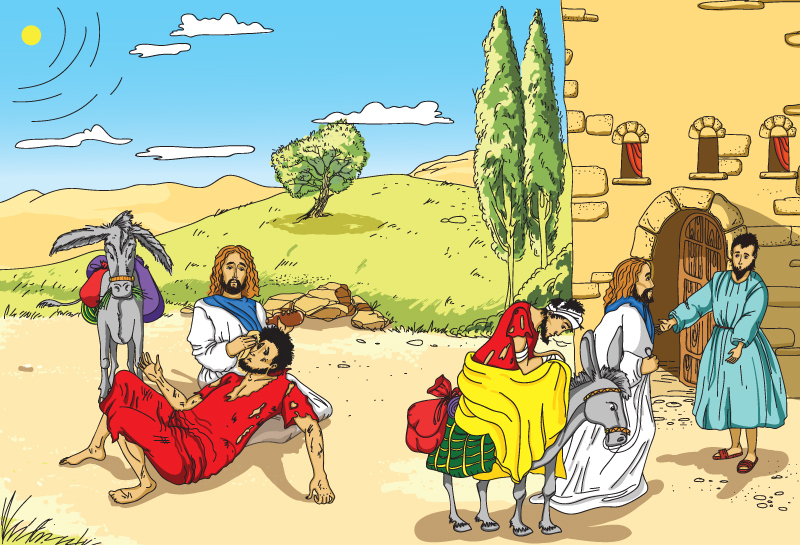
A wounded man lies on a road; a priest and a Levite see him but pass by; in contrast, a Samaritan stops, takes him to his inn, offers him oil and wine, and tends to him.
What lesson does this simple story convey? Over the centuries, there has been no shortage of answers. A canonical interpretation is that the injured man represents Adam, the Samaritan Christ, and the inn the Catholic Church. Kermode notes that St. Augustine adds that the oil provided by the rescuer symbolizes baptism and reflects on the journey the injured man was making: he was traveling from Jerusalem to Jericho, from his native land to the world, which includes the devil’s temptations. This last consideration suggests that the Samaritan acts like Christ toward sinners.

Every parable is shrouded in a veil that the reader must lift. The story of the Good Samaritan points to an essential issue: the definition of one’s neighbor. Beyond theological interpretations, it is worth reflecting on a detail obscured by custom. Two millennia after the events, the word “Samaritan” has become synonymous with one who does good selflessly. But the character’s original name carries another meaning; it is a demonym: the protagonist comes from Samaria. The detail is important because he is a stranger and, in a certain sense, an enemy. The story places him on the road from Jerusalem to Jericho, and Samaria is at odds with that region. For Jesus, the neighbor is not the next-door neighbor, the fellow countryman, or the relative, but the person who, though a stranger, becomes a neighbor.

Suggestively, in his book Black Sheep: Rebels of the 21st-Century Mexican Church, Emiliano Ruiz Parra associates the role of the chronicler with that of the Samaritan: he does not belong to that circumstance, but finds a way to draw near to it. The possibility of “being in the other” distinguishes journalism’s ethical character.

The theme has been expressed in many ways. Tennessee Williams gave it a twist of unsettling irony in A Streetcar Named Desire. The protagonist, whose illusions are stronger than reality, closes the drama with the line: “I have always trusted in the kindness of strangers.”

True to its logic, fate surprises us. A stranger donated his blood with no other purpose than to help people he knew nothing about. We know his name: Emmanuel, “God with us.” The story has the makings of a miracle, but it also has intrigues on a secular level. How is kindness defined?
The old parable has come true again: a stranger is our neighbor.

Further Reading: