
I’m constantly asked about the health of the U.S. economy, and the answer is mixed, since it depends on the point of comparison. In principle, the economy is strong, with sustained growth between 1.5% and 2%, an unemployment rate of just 4.1%, and inflation at 3.4%. Home and auto sales are somewhat weak and below last year’s levels, but the number of unemployed people is slightly better than it was 12 months ago, as is the number of job openings. On the other hand, there are strong headwinds, such as the conflict in Iran—which has now lasted six months instead of the six weeks Trump originally predicted—leading to high oil prices due to the very complicated passage through the Strait of Hormuz, as well as conflicts with neighbors to the north and south—including the breakdown in negotiations to renew the USMCA, the sharp increase in tariffs on Canadian products, and the ongoing dispute with Mexico and “drug-linked politicians,” with visa cancellations and threats to use force to combat the cartels.
The stock market seems to be ignoring these problems, and with companies reporting a 39% increase in profits compared to last year, indices have reached all-time highs, although the “Magnificent Seven” haven’t done much in the last four months. The country’s debt has risen to $40 trillion—double what it was 10 years ago—and with a projected deficit of $2 trillion this year and $2.1 trillion next year, it seems to be growing indefinitely. The debt-to-GDP ratio rose from 31.5% to 102% over those 10 years. Job creation has averaged 44,000 per month in 2026, compared to 124,000 in 2025, but the unemployment rate remains at 4.1%, perhaps due to deportations and lower immigration, which have reduced the labor force. Spot money markets stand at $8.3 trillion, indicating ample liquidity, and the stock market multiple (S&P 500) fell from 22.1 to 19.9 as profits rose. This development contradicts the notion that stock markets are overvalued.
Investors require higher interest rates to continue buying securities from an issuer that is becoming increasingly indebted, and Treasury bond yields reached 4.75% for 10-year bonds and 5.25% for 30-year bonds—the highest levels in 20 years. Adding to the uncertainty are the November midterm elections, in which the Democrats could retake the House and Senate—and would likely seek to impeach Trump and remove him from office. I don’t think this will happen, and I feel that the socialist movement within the Democratic Party has alienated many centrists who don’t believe that extremism is what will help the people. I feel that this polarization within the party will prevent them from winning enough seats to control the Chambers.

The explosion of artificial intelligence has sparked major controversies, ranging from the potential loss of many jobs and the obsolescence of many workers to improvements in quality of life through greater knowledge and the ability to create new solutions to problems that once seemed unsolvable. What is undeniable is that, financially speaking, the resources needed to develop the infrastructure to support AI are enormous and are already putting pressure on the markets, with issuances already totaling more than $300 billion and expectations that they will exceed $4 trillion by 2030. What is curious is that today’s debt issuers are the very companies that, until a year ago, were massive cash flow generators—such as Google, Microsoft, Amazon, and others.

There is no doubt that the most disadvantaged segment of the U.S. population is going through a difficult time, as wage growth lags behind inflation and money buys less and less each day. High interest rates make buying a home prohibitively expensive, as mortgages are very costly, and the burden on those in debt is immense; credit card balances and other debts require increasingly onerous payments. The tax rebates resulting from the tax law changes introduced by Trump were beneficial and sustained consumer spending for 3–4 months, but that phase has passed, and we cannot rely on partial solutions to a larger problem.
Partial solutions will not solve the massive deficit. The country must take the bull by the horns: modify social programs, overhaul Social Security and Medicare, cut unnecessary spending, rein in government waste, and tackle inflation to lower interest rates and reduce the burden of debt service. These measures will be difficult, painful, and politically contentious, but if the problem isn’t addressed now, it will become increasingly difficult to cure the country’s economic ills.
The United States is putting significant economic pressure on Iran by cutting it off from international banking systems, imposing tariffs and sanctions on countries that trade with it, and limiting its access to products from the Western world. Russia has indeed been included in all these penalties, but China—the main buyer of Iranian oil—has not. It will be interesting to see what happens after the September 24 meeting between Trump and Xi Jinping.

Turning to some interesting news from the United States this month, life expectancy reached 79.1 years—the highest in history. Deaths from heart disease have fallen by 39% since 2000 and by 62% since 1980. Cancer deaths have declined by 33% and 31% over the same periods. If the Strait of Hormuz were closed, the route around the Cape of Good Hope would take three weeks longer, and upon reaching Panama, the wait to cross the Canal is 11 to 17 days. An immediate passage permit is auctioned off every day, and last week the winner paid $5.3 million. Incidentally, Panama forecasts that due to the El Niño weather phenomenon and low water levels toward the end of the year, only 23 ships per day will cross the Canal, instead of the average of 36 ships per day.

Although communication between Trump and Fed Chairman Warsh continues, the expectation is that interest rates will rise to combat inflation—not fall, as Trump had hoped. In the billion-dollar dance, NVIDIA continues to rake in fortunes and invest in its customers’ new facilities so they’ll buy more chips. There’s no doubt that there will be big winners in AI, but there will also be losers who will have invested heavily and won’t be able to repay their loans. The cost of insuring the debt of large AI companies has doubled in the last six months, reflecting the uncertainty in the industry. By the way, Google Gemini said it has now surpassed 1 billion monthly users, which sounds enormous—though I suppose many are repeat users.

The latest consumer reports show strong momentum, and the University of Michigan’s consumer sentiment index remains positive, though only slightly above the neutral level. On the other hand, manufacturing reports remain solid and point to a healthy economy; despite this, the Conference Board, the business sector’s umbrella organization, reported a sharp decline in the expectations of top business leaders, although they believe their companies’ average growth will be 4.3% over the next five years—albeit with 8% fewer employees.
It is interesting to see how opposition to data centers and AI processing facilities has grown in many states due to their high energy consumption and sheer size. This is another challenge that large AI companies will face in the future. One statistic I found alarming was that property insurers fail to pay out on 45% of covered claims for various reasons, which casts doubt on the value of what is paid for insurance. Vietnam has the largest trade surplus with the United States, with exports exceeding imports by $123 billion. In the United States, private equity funds own 13,500 companies—twice as many as those listed on the stock exchange.

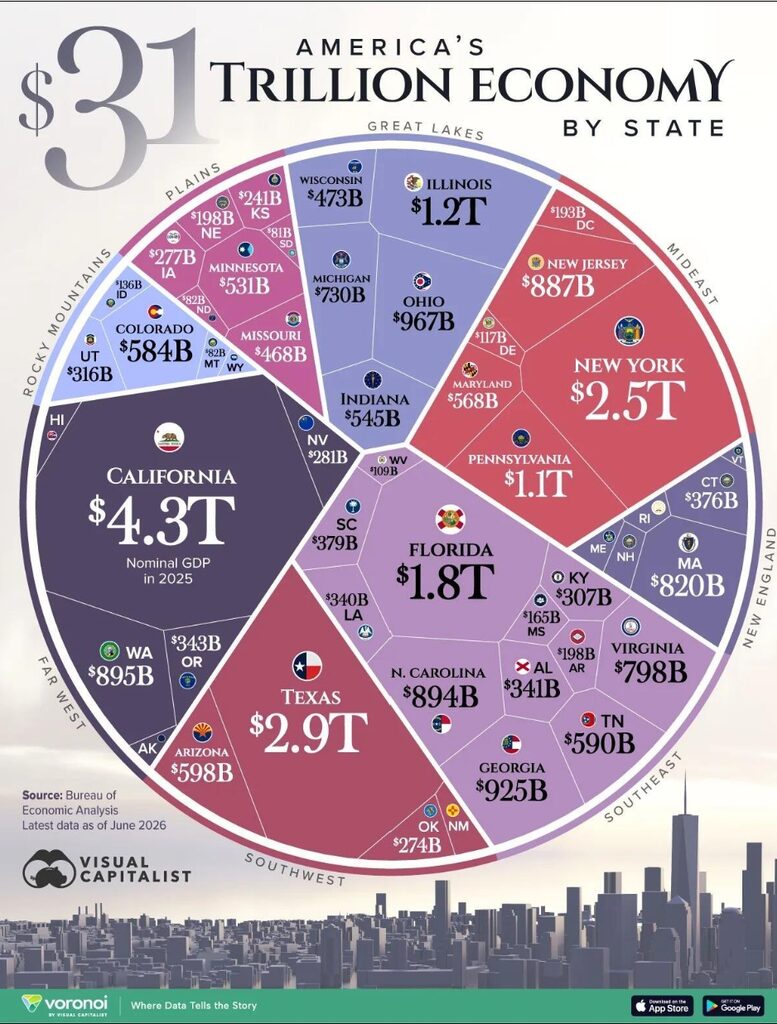
Last year, 1,601 homes priced above $10 million were sold in the country—35% more than the previous year—but the national average price of a home sold remains at $410,000, unchanged over the past five years. It’s interesting to see where the S&P 500 companies—the largest in the country—are concentrated. Texas 57, California 56, New York 53, Illinois 29, and Virginia 24. Six states account for 45.5% of the total! To wrap up this section on interesting facts, 41% of all medications are produced exclusively in China, and last week the ocean surface temperature reached 70° F—the highest on record.
Mexico is going through very difficult times with an internal struggle within Morena, a crisis resulting from the confrontation with Trump, and the accusations and visa revocations targeting many governors, as well as the apparent rift between President Sheinbaum and former president AMLO. The tragicomedy of Rocha Moya’s return to the governorship of Sinaloa for a few hours appears to be the first sign of discord among Morena’s top leaders. The ridiculous letter from AMLO’s son addressed to Trump—in which he denies all accusations against him, demands that Marco Rubio be removed from office, and accuses the United States of political maneuvering—is a clear manifestation of the lack of respect for the law in Mexico. Exonerating Rocha Moya of any involvement in drug trafficking and fuel theft when all of Mexico knew what he was up to is inexplicable and definitely detrimental to relations with our northern neighbor.

Business in Mexico, for the most part, is not doing badly, as consumption among its 135 million inhabitants continues unabated; however, when it is reported that 82% of the 599,000 new jobs created are informal, it is obvious that the country will remain mired in its current economic crisis. It is estimated that 55.1% of all jobs are informal. The budget deficit will exceed 6% of GDP, and there are no longer sufficient resources—not only to invest in necessary infrastructure but also to cover the day-to-day operations of hospitals, schools, and so on. The social spending introduced by AMLO is here to stay and is a noose around the neck of a developing country with many shortcomings.

As I do every month, I’ll list some positive and negative reports regarding Mexico.
Positives:
· Analysts raised the GDP forecast from 1.1% to 1.2%. The government estimates it will rise from 1.8% to 2.8% by 2027. ECLAC lowered its 2026 forecast from 1.5% to 1.3%.
· The use of fracking to extract more oil and natural gas has been approved.
· GAP (airports) reported its first increase in passenger numbers in seven months, as did Volaris.
· Inflation in July was 3.82% due to a decline in agricultural products, now within Banxico’s 3% ± 1% target range.
· The avocado dispute was resolved, and exports have resumed.
· Construction offset manufacturing, ending the month with positive figures.
· The peso reached its highest level in 20 months, partly due to the dollar’s weakness, the impact of high oil prices, and the “carry trade,” in which speculators borrow in low-interest-rate currencies to invest in CETES with a spread of more than 6%.
· Tourism set a record in the first half of the year, both in terms of visitor numbers and revenue.
· 514,000 metric tons of cargo have already been moved through the Tehuantepec interoceanic transport corridor.
· Mexico leads Latin America in global capital investment for the second quarter of the year.
· Exports in the first half of the year grew by 24.6%. Sales of computer equipment and electronics surpassed those of cars—which remained flat—and trucks—which declined.
· Mexico unveiled the OLINIA light pickup truck, priced at 150,000 pesos.
· There was a current account surplus of 8.92 billion.
Negatives:
· Although foreign exchange reserves reached a record high of $258.6 billion, the growth rate has slowed due to fewer migrants and deportations. We don’t know how much of this represents actual remittances and how much is money laundering.
· Automobile manufacturing has declined due to falling sales in the United States.
· July was the worst month for formal job creation in 10 years.
· INEGI published poverty levels: rural 3,554 pesos/month, urban $4,929. These figures seem extremely low to me, and I feel that someone earning $5,000/month is still very poor.
· Honda announced that it will not build its new plant unless the renewal of the T-MEC is finalized.
· Freedom of the press has effectively come to an end with the new regulations published in the official gazette.
· Foreign investment in Mexican bonds had its second-worst month since 2009.
· Coparmex said this was the worst year for extortion of businesses in the last 11 years. Violence and crime remain very high.
· The United States accused strawberry producers of dumping.
· Foreign direct investment fell 3.5% in the first half of the year.
· Imports of Chinese vehicles reached 69.7% of the total. They grew 21.4% in the first half of the year and now account for 20% of total sales.
· The new environmental law will significantly impact the mining sector and halt foreign investment in this area.

In a brief analysis of the rest of the world,
Israel had a spectacular second quarter, with annualized GDP growth of 15.4% (3.6% compared to the previous quarter) after a very poor first quarter in which it contracted by 2.2%. All sectors improved, from exports to consumer spending and government spending. Tech companies received $600 million in new investments during the month and have already raised $9.6 billion so far this year. Concerns remain regarding the conflict with Lebanon, the war in Gaza, and developments in Iran, although much there depends on the actions taken by the United States. Elections for prime minister will be held on October 27, and no clear winner is in sight, as no party holds more than 25% of the seats in the Knesset. The party with the most votes is expected to face significant challenges in forming a coalition that secures the 61 seats needed to govern.

In China, the economy is slowing, and growth is now expected to be only 4%, prompting the government to launch a program of fiscal and economic incentives. Banks collected 590 trillion yuan more than they lent—a clear sign of low investment. Car sales fell 20.9% and home sales 7.3%—serious figures for an emerging economy. The CEO of Evergrande, the country’s largest residential homebuilder, was sentenced to life in prison for fraud, even though the massive construction of homes—which now stand vacant and led to the economic crisis three years ago—was part of a government initiative to boost the economy.
Another Asian country struggling is Japan, where consumer spending continues to fall; the yen hit a 20-year low, and only a massive intervention by the Central Bank halted the decline. The shrinking population is reducing consumption, and the lack of immigration is causing the economy to grow slightly smaller with each passing year.

Russia has taken advantage of rising oil prices, but the war with Ukraine has taken a huge toll in terms of money and lives and shows no sign of ending. Interestingly, Russia exported $4.9 trillion worth of agricultural products to China in the first half of the year.

The rest of Europe experienced moderate growth, slowed by a severe heat wave that affected agriculture and caused river levels to drop significantly, hampering navigation. In Europe, 19% of buildings have air conditioning, compared with 90% in the United States.

Saudi Arabia announced it will build several amusement parks in France with a $6 billion investment.

In a surprising statement, the United Arab Emirates projected that next year the global oil supply will fall by 4% and consumption will drop by 1.8 million barrels per day. At the same time, Abu Dhabi announced the purchase of two ships to transport liquefied natural gas for $440 million. They also stated that they would prefer Iran to retain control of the Strait of Hormuz if the alternative is a war that would endanger their facilities and ships.

Finally, in news from the rest of Latin America, bankruptcies in Brazil increased by 12% compared to last year, and inflation remains above the 5% target set by the Central Bank, even though interest rates remain above 14%. The upcoming presidential election on October 4 is a tight race between Flávio Bolsonaro, the son of the former president who is under house arrest, and Lula, the current president, whose son has been accused of embezzlement. Neither option is particularly appealing. Brazil is one of the few countries offering to host large data centers for artificial intelligence companies, and rumors suggest talks are already underway with two of them.

Colombia has seen a very favorable response to the change in government and Petro’s departure, attracting significant foreign investment that has greatly strengthened its currency. Incidentally, it has resumed coal exports to Israel, which the previous administration had suspended. Chile has taken advantage of rising copper prices. For the first time in many years, the government allowed the national copper company, Codelco, to retain the $2.42 billion it generated to invest in new projects rather than diverting those funds to government programs. Venezuela has signed agreements with several U.S. companies that will make major investments in the oil sector. Exports have already grown by 19% compared to levels under the Maduro administration.

The markets had a challenging August, with stock indices reaching all-time highs before falling slightly; bonds had a very bad month as interest rates continued to rise; gold jumped nearly $500/oz before giving back $200/oz; Bitcoin recovered 22% of its value to $77,500; and stablecoins showed a slight upward trend.

Further Reading: