The Moral Superiority of Trump and Claudia Sheinbaum Explored.

The content critiques the contradictory behaviors of leaders Donald Trump and Claudia Sheinbaum, highlighting their moral superiority perceptions that justify authoritarian actions. Trump’s peace campaign has led to aggressive foreign policies, while Sheinbaum positions herself as a transformative force in Mexico, both forgetting their initial promises in pursuit of power.

The Risk of the Electoral Counter-Reform on Mexico’s Democracy.

Mexico’s electoral reforms since 1958 reshaped its political landscape, but left unresolved issues similar to those of revolutionary France. Current counter-reforms by the Morena party aim to centralize power, risking democracy’s integrity. Historical patterns suggest a potential shift toward authoritarianism, echoing past mistakes in governance and stability.

Three Videos on Iran, Trump, and The World.

Thomas Friedman discusses U.S. strikes in Iran on Morning Joe. Canadian Prime Minister Mark Carney speaks at the Lowy Institute about global tensions and strategic alliances with countries like India and Australia, emphasizing diplomacy. David Brooks and Jonathan Capehart analyze the U.S. political landscape, focusing on the economic uncertainty amid recent military actions.

Mexico And Organized Crime: What’s Next?

Criminal organizations have an increasingly diversified and complex business portfolio. From their traditional activities—production, trafficking, and marketing of narcotics—they have expanded into fuel smuggling, transportation, extortion, kidnapping, private security, the construction industry, and a long and imaginative list of other activities. Organized crime was and is a very important power center in Mexico, which was already conveniently fragmented. Within this criminal framework, which is not monolithic, there is a constellation of organizations that compete with each other, fighting ruthlessly for business, where the only law is the one each imposes in its own realm, because that is the only way to survive.

Luis Maizel’s Monthly Letter: A World That Changes In A Flash.

The recent attack on Iran eases global tensions, impacting groups funded by the regime. While the U.S. economy shows signs of strength, disparities between social classes persist. In Mexico, significant events like the death of a drug lord and mixed economic signals define the landscape. Global markets face volatility amid geopolitical shifts.

Israel-Iran: One of them has to disappear.

When this war ends, which I hope will be soon, one of the two countries—Iran or Israel—will have had to change its political, military, or security structure substantially. What is at stake is not a minor adjustment, but the very survival of the Iranian regime or, at the extreme, the strategic viability of Israel in a regional environment that has become reactive.

The Delcy Rodríguez Model for Political Transition.

The Trump administration’s plan for Venezuela involves Vice President Delcy Rodríguez governing until new elections can be conducted, aiming to prevent chaos after Nicolás Maduro’s removal. The strategy hinges on U.S. control over oil revenues and avoiding military intervention, paralleling potential transitional models in Cuba and Iran.

Anthropic’s Response to Military Restrictions on AI.

In an interview with CBS News, Anthropic CEO Dario Amodei responded to Defense Secretary Pete Hegseth’s classification of the company as a supply chain risk, which limits military contracts. Amodei criticized this decision as retaliatory, emphasizing the importance of establishing ethical boundaries for AI technology to align with American values.

Blow and Struck Back.

The Mexican government is responding in extreme terms to two events that have changed the internal and external political and military situation. The ruling party’s response to events, apparently unrelated: the location and subsequent death of Nemesio Oseguera Cervantes (Mencho), and the government of Claudia Sheinbaum’s proposal for political and electoral reform.

The Illusion of Security in Mexico.

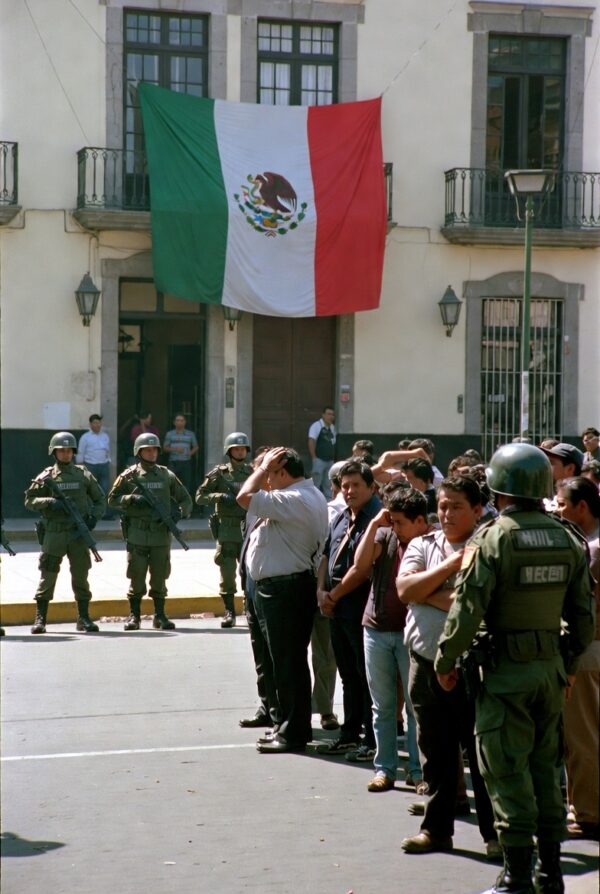
Recent violence in Mexico highlights the failure of government strategies to manage organized crime. Previous approaches assumed negotiation or addressing poverty could reduce crime, but these have proven ineffective. The state struggles against deeply embedded criminal organizations, now a direct challenge to sovereignty. Public safety and economic stability must be prioritized.

Shares