
Mexico Under Siege: Exploring Government Mismanagement

Mexico is facing internal and external crises, exacerbated by a government blind to reality. Economic mismanagement, excessive subsidies, and a lack of investment confidence are driving the nation towards stagnation. The government’s denial of its failures and refusal to accept criticism contribute to severe challenges, both domestically and internationally.

Reform or Fall Behind: India and Mexico.

Donald Trump’s influence has spurred India’s Prime Minister Narendra Modi to embrace urgent reforms, shifting the country from complacency to rapid development. Infrastructure projects and policy changes are ongoing, fostering a proactive mindset among business leaders. Despite economic slowdowns, India’s focus on long-term growth and competitiveness may position it favorably in global markets.

Cuban Resilience Amid U.S. Political Pressures

In 2016, Raúl and Alejandro Castro negotiated an agreement with Obama for a market economy in Cuba while retaining the Communist Party’s power, akin to the Vietnamese model. Fidel Castro rejected this idea, exposing Cuba’s long history of dependency on foreign support. Presently, the island faces severe economic challenges and resistance to U.S. demands, with the potential for humanitarian crises looming.

Trump’s Unfinished Victories.

As the hours pass, the war waged by Israel and the United States against Iran threatens to become a protracted conflict, much like the war in Ukraine. The mix of politics and war is proverbial: we know who starts the war and when, but we never know when it will end or under what conditions.

Auf Wiedersehen

In the late 1970s, Mexican social sciences were predominantly Marxist, minimizing other theories until the emergence of the Frankfurt School, which introduced diverse critical perspectives on society. Influenced by scholars like Habermas, these ideas emphasized dialogue and intersubjectivity, ultimately expanding philosophical and democratic thought.

Trump’s Shield Threatens Sheinbaum.

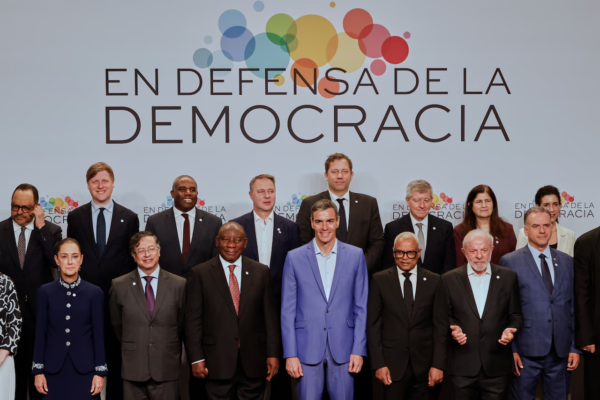
Trump’s summit with 12 Latin American presidents aimed to form a military coalition against drug trafficking but resulted in no concrete agreements. The meeting highlighted a conservative shift in the region, excluding left-leaning countries. Trump’s stance on Mexico, perceived as a drug trafficking hub, raised concerns about its international isolation and vulnerability.

The Worst of the War.

What some in Washington once imagined as a possible political evolution ended up becoming the establishment of a radical clerical power that redefined the strategic balance in the Middle East for decades. Since then, the world has paid—and will probably continue to pay for a long time to come—the consequences of that historic turn of events. The worst thing about war is not what has already happened, but what may come in the form of revenge, score-settling, and miscalculation.

The Moral Superiority of Trump and Claudia Sheinbaum Explored.

The content critiques the contradictory behaviors of leaders Donald Trump and Claudia Sheinbaum, highlighting their moral superiority perceptions that justify authoritarian actions. Trump’s peace campaign has led to aggressive foreign policies, while Sheinbaum positions herself as a transformative force in Mexico, both forgetting their initial promises in pursuit of power.

The Delcy Rodríguez Model for Political Transition.

The Trump administration’s plan for Venezuela involves Vice President Delcy Rodríguez governing until new elections can be conducted, aiming to prevent chaos after Nicolás Maduro’s removal. The strategy hinges on U.S. control over oil revenues and avoiding military intervention, paralleling potential transitional models in Cuba and Iran.

AMLO: Priest of the São Paulo Forum.

The post critiques Andrés Manuel López Obrador (AMLO), comparing his governance style to Evo Morales, emphasizing corruption within the Mexican political system. It outlines the adherence to the São Paulo Forum’s principles, highlighting manipulations of the judiciary and military. Despite initial success, the author argues this approach is ultimately doomed to fail, leaving Mexico isolated.

Shares