Luis Rubio
“Who will guard the guardians?” the Roman poet Juvenal once asked. Perhaps no question is more important to Mexico’s future than this: What does the president want the power she has accumulated for, and what are its limits?
Step by step, the government has set about dismantling every remaining check, counterweight, opposition force, or institutional obstacle to its rule. Its appetite for control expands by the day. Yet, little by little, it is encountering the limits of its own ambition, revealing the paradox of power: the attempt to control everything ultimately leaves you controlling almost nothing. The more rigid power becomes, the more vulnerable it is to fracture.

The emperor Marcus Aurelius described absolute power as an illusion. In his Meditations, he observed that one of the peculiarities of power is that one can do good and be damned for it. Excessive power eventually becomes an illusion—not that those who wield it necessarily recognize this or are willing to relinquish or modify it.

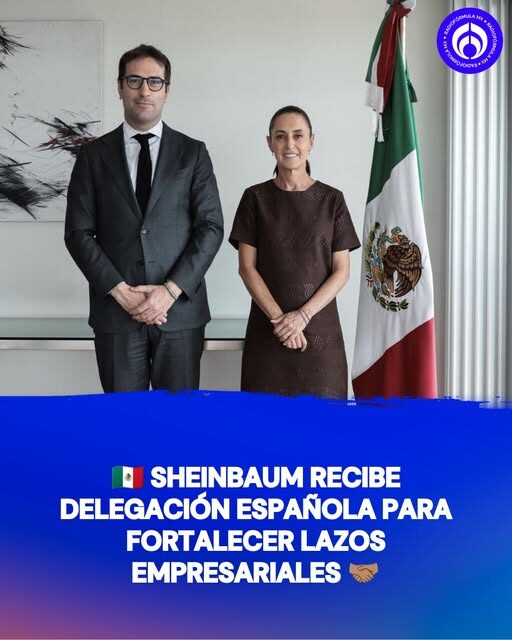
Claudia Sheinbaum began her six-year term by assuring investors that she would guarantee clear rules and that their investments would be safe. Her word, she implied, would be enough. The problem is that no investor can rely exclusively on the word of a ruler, both because a ruler’s tenure is temporary and, more importantly, because what matters to an investor—and, it should go without saying, to an ordinary citizen—is not the ruler’s word but rules that endure beyond the ruler who happens to be in office.
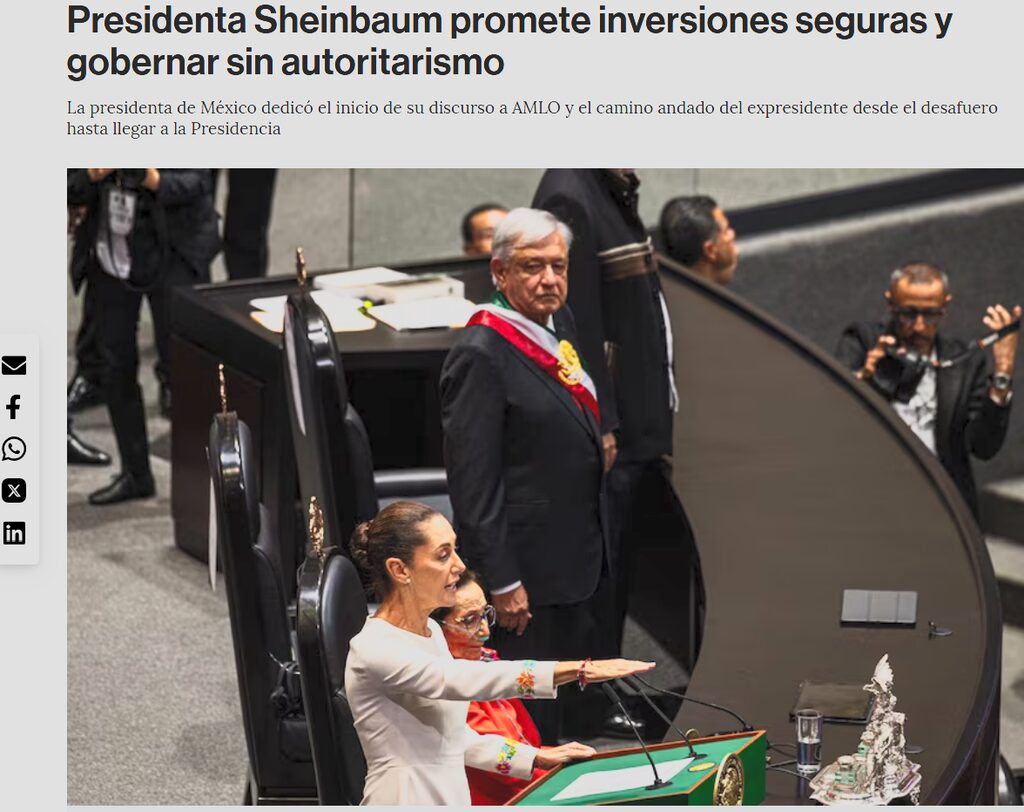
Even more troubling, the president made those assurances only days after Congress had approved a series of constitutional reforms that began the formal destruction of what few institutional checks remained, starting with the judiciary. The dismantling of the autonomous agencies responsible for competition, telecommunications, energy, and other areas would follow. Rather than reinforcing her promise of guarantees with tangible evidence, the government proceeded down a path that steadily undermined them until the promise itself became impossible to believe.

Yet the government does not acknowledge the contradiction between its promise of clear rules and the concentration of power that followed. This is why the repeated invocation of the so-called “Mexico Plan” amounts to little more than an abstraction. Except for businessmen whose fortunes depend on their proximity to government, the idea that an independent investor or entrepreneur will risk capital without reliable rules, autonomous mechanisms for resolving disputes, and effective institutional checks is nothing more than a fallacy—a comforting illusion.
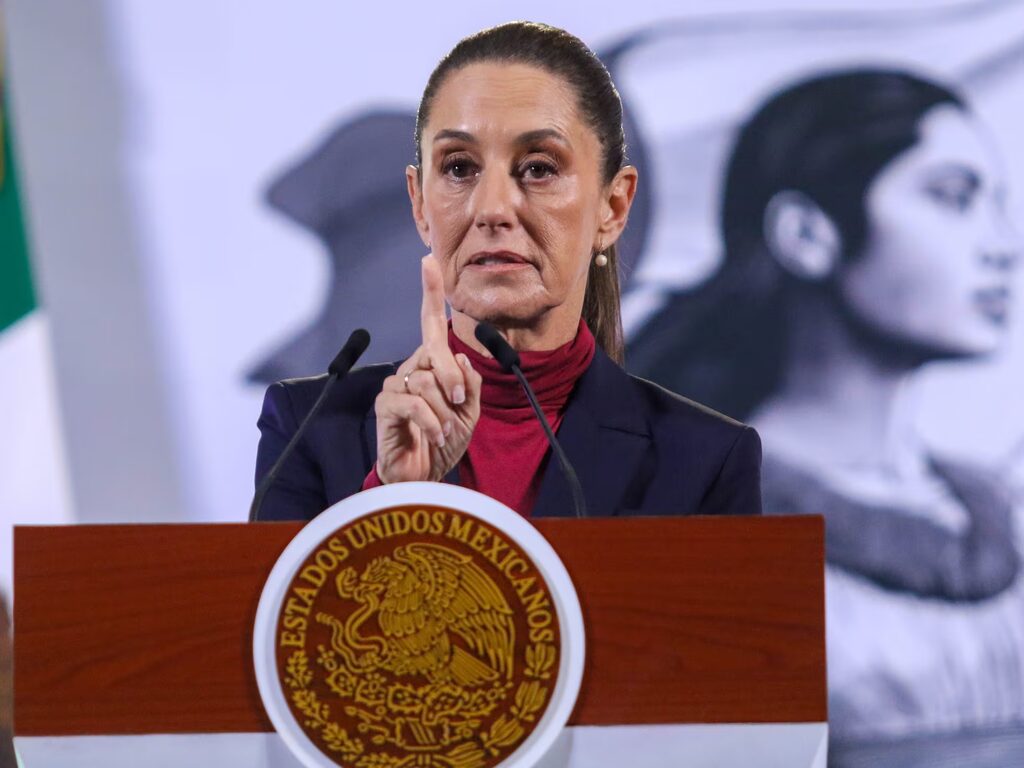
Worse, the government has persisted in its mission to control everything. The initial wave of reforms has been reinforced by subsequent legislation governing digital control, constitutional injunctions, and, most recently, media censorship. Beyond the laws themselves, the daily exercise of power—particularly visible in the president’s morning press conferences—reveals an unwavering desire to eliminate every source of dissent, disagreement, or criticism.
Whatever happened to the recognition that Mexico needs private investment, even if the government regards it as an inevitable evil?
The direct attacks launched from the presidential podium against journalists, commentators, media outlets, and critics are merely another manifestation—albeit a more dangerous and troubling one—of a project aimed not only at controlling the machinery of the state and the administration of government, but also at controlling citizens’ minds. In the president’s own words, it is a fascist project.
And yet, despite her use of that term, I am not convinced that the president recognizes the implications of her own interpretation of the political environment—particularly as the U.S. government steadily, patiently, but unmistakably, closes in on former president López Obrador.
Little by little, it is becoming clear that all this control, all this power, has real limits.
Michel Foucault observed that “where there is power, there is resistance.” Banning, threatening, intimidating, and monitoring are all instruments of power, but they are effective only within an authoritarian context.
The question of who will watch the watchers—and who will hold the powerful accountable— is becoming more than a rhetorical one. The authoritarian impulse is visible in the government’s words, laws, administrative actions, and conduct. But, fortunately, its ability to actually implement all of this is limited.
The day the government recognizes that, before it can control ordinary citizens, it would first have to control the extortionists—the ones within the government itself as well as those belonging to organized crime—that may be the day its authoritarian project begins to produce results.

Until then, the drive toward absolute control will ultimately boomerang against the government’s own project of economic growth. No one in his right mind will invest or put capital at risk in an environment like the one that characterizes Mexico today. Those who depend on government and profit from their proximity to it certainly will. But that has little to do with the growth of the economy as a whole.

In 1979, Octavio Paz described the Mexican government in The Philanthropic Ogre as a “patrimonial state”—one in which the prince, or the president, regards the country as his personal property.

After enormous efforts to break with that tradition, history is repeating itself.

Only this time, it is repeating itself as a farce.

@lrubiof
The original Spanish version of this article can be found at www.luisrubio.mx
Further Reading: